How first-time visitors shop for rental cars
A competitive diary study into why new-user growth was flat. Most shoppers never found Turo while planning a real trip, and even those who explored it directly couldn’t get a clear enough read on the experience to choose it over a rental company they already knew.
via dScout
Background
New-user growth was flat, and the company was looking at the funnel for the cause. I wanted to look earlier.
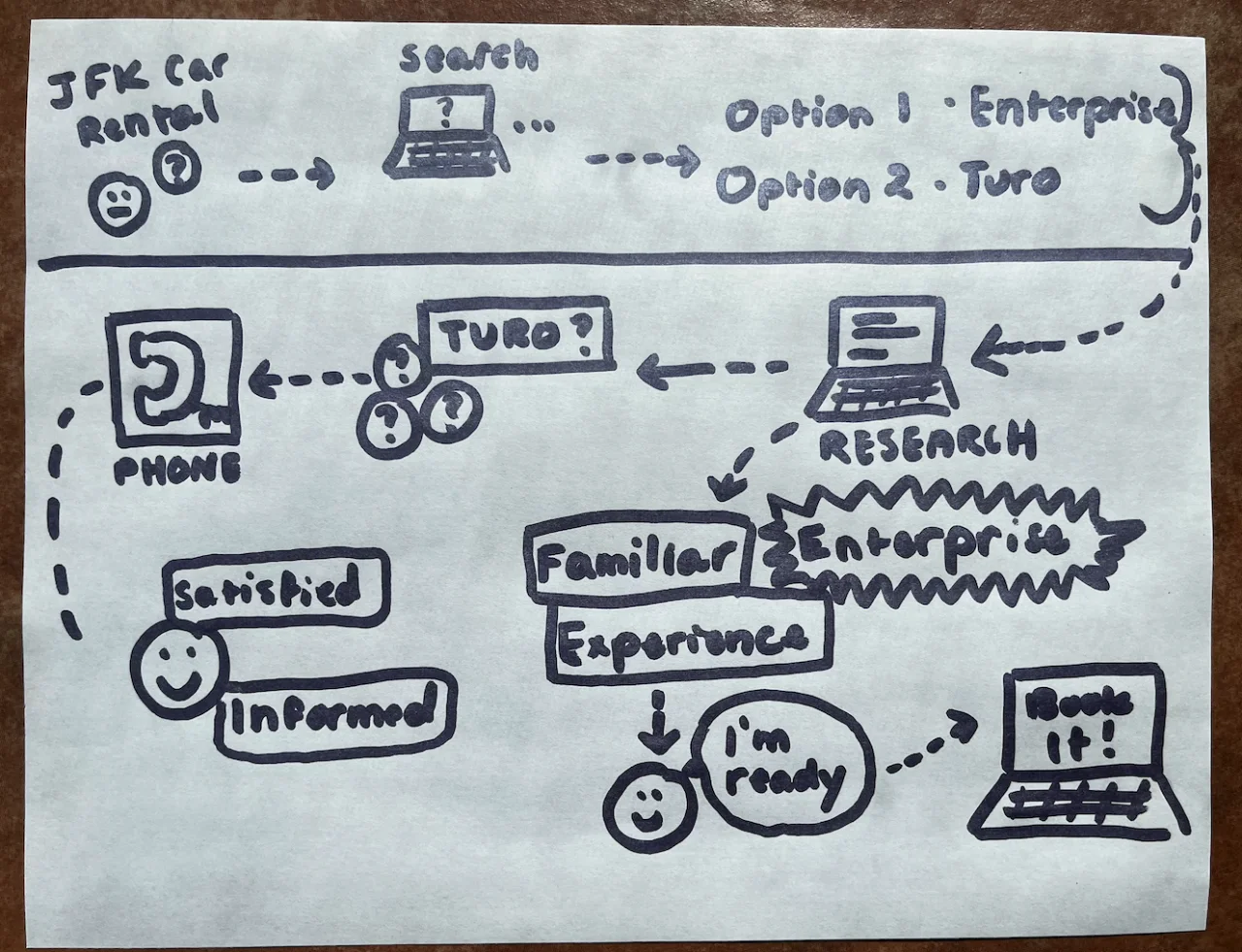
A first-time visitor doesn’t start at Turo: for a real trip, people book the flight first and the rental car later, once arrival times are set. By then they’re already partway through a process that began somewhere else. So I studied the whole process, not just the part that happens on Turo’s pages.
Research design
Rental car shopping doesn’t happen in one sitting. People check a price, close the tab, ask a friend, look again the next day, weigh it against the flight they already booked. A moderated session would compress all of that into a single artificial window, and a researcher watching live tends to change how people shop, especially around price, where they can feel judged for how they go about it. A diary study avoided both problems, letting participants shop on their own time, in their own context, and capture it as they went.
The study ran through dScout in five parts:
The organic task captured natural behavior, while the dedicated Turo step guaranteed a read on the product from people seeing it for the first time, whether or not it surfaced on its own. Everything came in as video, screen recordings, and written reflections from participants’ phones, in the moment.
What I found
Most participants were flying somewhere and renting at the airport, and watching them shop showed the routine Turo had to break into. They went to rental car company sites and travel sites like Expedia and Kayak, used Google and airport websites to see who was located directly at the airport, and checked reviews when a provider was unfamiliar.
A few things came up for everyone: a full total shown early, fees included; no account required to see a price or book; a clear read on where the car would be. That was the baseline Turo would be measured against. Three findings, caught at different moments in the study, showed what was costing it first-time guests.
Left to shop on their own, most people never found Turo
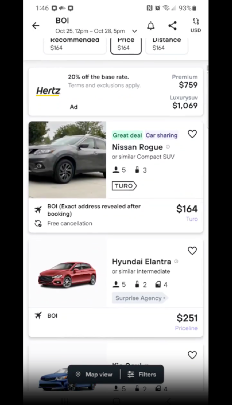
In the organic task, 10 of 11 participants never came across Turo. It turned up in none of the places they looked: not in Google results, not on airport sites, not on most travel sites. One participant did find it, a single Turo listing on Kayak, and it was the cheapest car on the page. They skipped it anyway. The listing carried the same airport icon as the rental companies around it, but instead of a confirmable airport location it said the exact address would be revealed after booking. For a price-sensitive shopper who wanted a car waiting at the airport, that was enough to read it as off-site and move on. Turo won on the one thing this person was optimizing for and still lost, on a line of copy about location.
“This is kind of a red flag to me. This one is going to be off-site and I have to go some place.”— Participant, on the only Turo listing anyone encountered organically
The experience was too opaque to choose over a known alternative
In the Turo step, all 11 participants explored the product directly, including the one who’d seen it on Kayak. They liked real things: free cancellation, getting the exact car shown, the unusual cars. They grasped the basic model quickly. What they couldn’t do was picture the actual experience. Pickup, insurance, what happens if something goes wrong, the true cost: all of it stayed murky, so they stayed with the rental companies they already knew. One participant spelled out the worry:
“I’m really concerned about cancellation. If I rented with Hertz and one vehicle isn’t available, they put me in a different one. If a Turo host cancelled on me the Monday before Thanksgiving, all the rental prices might be inflated by then as I try to replace it. I can’t consider Turo unless they explain how they’d get me into a comparable car at a comparable price.”— Participant
Missing those answers, participants left the funnel to look on Google, Reddit, NerdWallet, and TripAdvisor, and the detour often cost the booking. Cost had its own wall: the full total only appeared after creating an account, so people had to sign up to see the number they most needed to decide. Only 2 of 11 made one.
The fun cars everyone loved weren’t why anyone booked
The unusual cars were noticed and enjoyed, but nobody was actually considering one for the trip at hand. For these leisure trips, priorities ran price first, then convenience of pickup, then reliability, with breadth of cars to choose from last. The flashy inventory even worked against Turo: with a $117-a-day car leading the results page, price-focused shoppers came away reading the whole platform as expensive. One participant’s first impression of the brand amounted to “we have sexy cars,” and dollar signs. There is an audience for the fun cars; a typical airport leisure trip just isn’t where it shows up.
Even at price parity, Turo read as the risky choice. An experience shoppers couldn’t predict didn’t beat one they could.
What I recommended
Each recommendation traced back to a place the study watched the funnel lose someone.
Outcomes
Because the study looked wider than the funnel it was scoped to examine, it ended up useful to more than the team that asked for it.
Marketing’s push for placement on third-party travel sites got concrete criteria to hold listings to, starting with showing a clear airport location, since shoppers skipped Turo the moment its location looked ambiguous.
Product got the specific questions standing between a first-timer and a booking: pickup, insurance, what happens if something goes wrong, and true cost. That replaced a vague mandate to build trust, and the fixes were ordinary ones, the kind that surface only when you watch people shop.
And the whole org got a grounded read on the competition in use: what rental companies and travel sites actually do well, like showing full totals early and not gating a price behind sign-up, and how Turo stacks up when a real shopper puts them side by side, a comparison that used to be guesswork.